Free live workshop 90 minutes Saturday, 8:00 PM IST Live on Zoom

The Loop is the
New Prompt.

Everyone is still typing prompts one at a time. The top 1% have already moved on. The leverage shifted from writing prompts to designing the system around the agent, and the loop that runs it.

A 90 minute live session that goes past the buzzwords into how production agents actually run unsupervised for hours, and how to build them yourself.

Live Q&A included Live build, agent runs itself Seats limited
The progression nobody mapped for you

From prompts to loops

Each era did not replace the last, it wrapped it. Most people are stuck two stages back. Here is the full ladder, and why every rung matters.

01

Prompt

A single instruction. Powerful, but you are the runtime: re-typing and re-steering every turn.

02

Context

Feed the model the right files, memory and history. Better answers, but still one shot and still supervised.

03

Harness

Everything around the model: tools, validation, memory, sandboxing. Agent = Model + Harness.

04

Loop

The system that runs the agent: find, do, verify, repeat, until the goal is met and you are out of the loop.

Harness Engineering

A raw model
is not an agent.

Model+Harness=Agent

The harness is everything in an agent except the model: every piece of code, config and execution logic that turns raw intelligence into a reliable work engine. It does two jobs. It steers the agent before it acts (feedforward), and it lets the agent self-correct before mistakes reach you (feedback). Get this right and you stop reviewing slop, because the system catches it first.
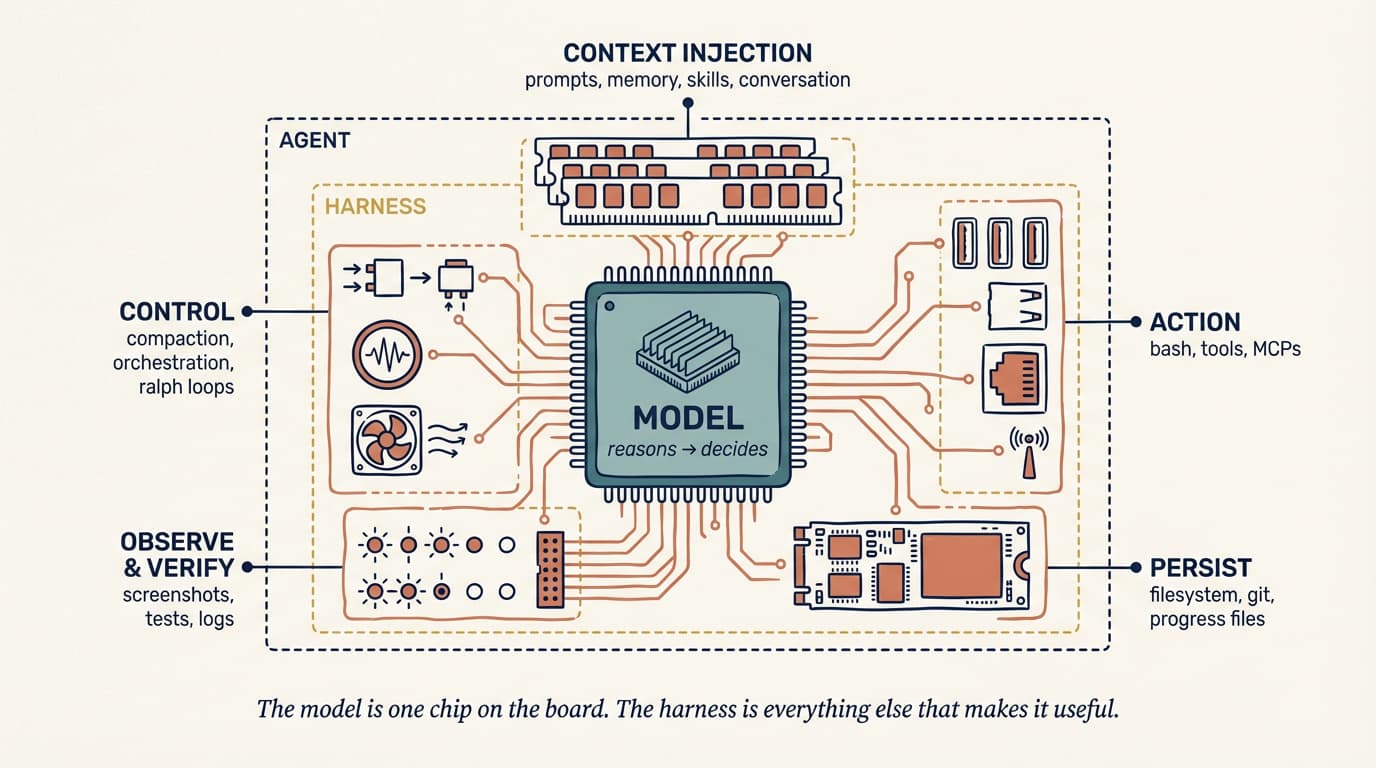
Diagram of an agent harness drawn as a circuit board: the model is one chip, surrounded by context injection, control, action, observe and verify, and persist.
The model is one chip on the board. The harness is everything else that makes it useful.  Diagram: Addy Osmani

Tools

The hands of the agent: search, edit, run, call APIs.

Validation

Tests, linters, type checks: the feedback that self-corrects.

Memory

What persists across turns so the agent never starts blind.

Sandboxing

Safe boundaries where the agent can act without risk.

Context

Delivering the right information at exactly the right moment.

Permissions

Guardrails on what the agent is allowed to touch.
Loop Engineering

Four loops that run
your agents for you

Loop engineering means designing the system that prompts your agent, instead of prompting by hand. Pick the wrong loop and nothing happens. Pick the right one and work gets done while you sleep. We break down all four, and when to use each.

Heartbeat

The agent wakes on a steady tick, checks state, and acts if there is something to do. Always on.

// every N seconds

Cron

Scheduled runs at fixed times: the nightly report, the 9 AM digest, the hourly sweep. Predictable cadence.

// on a schedule

Hook

Fires on an event: a PR opens, a file changes, a message lands. The agent reacts the moment it matters.

// on event

Goal

Keeps looping (plan, act, verify) until the target is actually met, not just until one turn ends. The deepest loop.

// until done
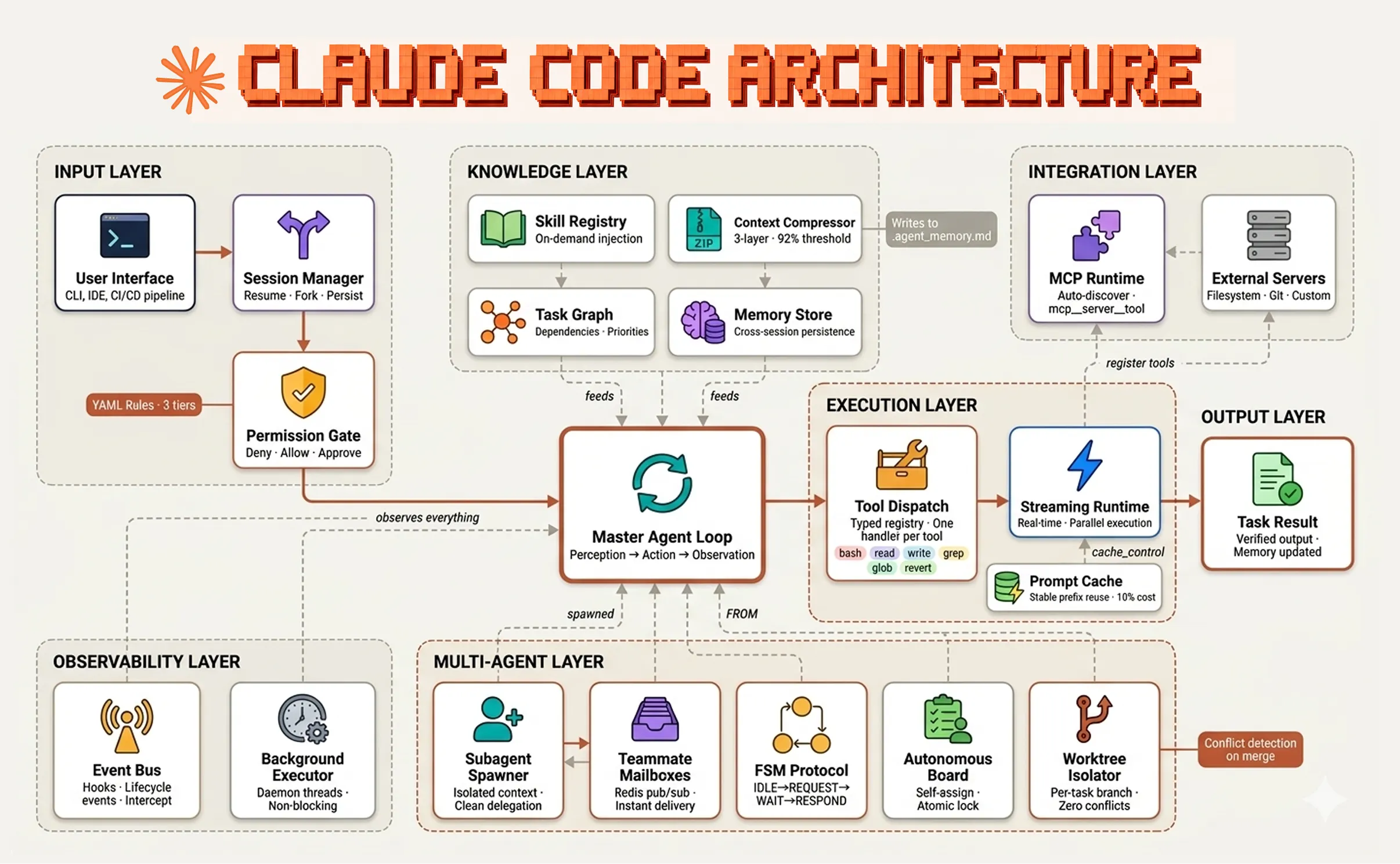
Layered architecture diagram of Claude Code showing input, knowledge, execution, output, observability and multi-agent layers around a master agent loop.
What a real harness looks like in production: Claude Code, layer by layer, with the master agent loop at the centre.  Diagram: Addy Osmani / Fareed Khan

In the session we walk this diagram live, and show exactly how Claude Code and Codex implement these loops under the hood.

The shift is already happening

The people who build the agents
are already writing loops

This is not a hot take. The builders behind the top coding agents have moved from prompting to loop design. This workshop shows you how to do the same.

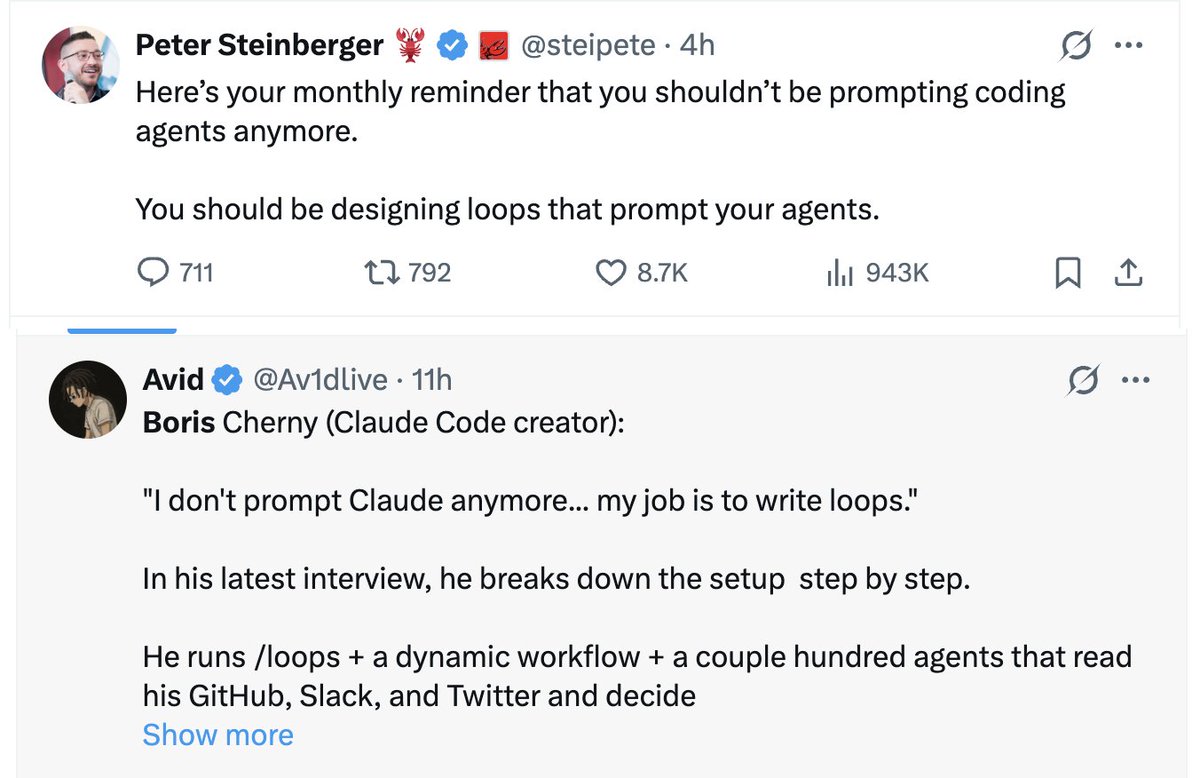
Tweets. Peter Steinberger: you shouldn't be prompting coding agents anymore, you should be designing loops that prompt your agents. And Boris Cherny, the Claude Code creator: I don't prompt Claude anymore, my job is to write loops.
Peter Steinberger (@steipete), and Boris Cherny, creator of Claude Code, via @Av1dlive.  Screenshots from X.
90 minutes, what you walk away with

The agenda

A clear mental model, plus a live build you can recreate yourself the same day.

01

The real progression

Prompt → Context → Harness → Loop, and why each one matters.

02

Harness Engineering, in depth

Tools, validation, memory, sandboxing, and the Agent = Model + Harness formula.

03

Loop Engineering, in depth

Heartbeat, cron, hook and goal loops, and exactly when to use each.

04

Under the hood

How Claude Code and Codex actually implement their loops.

05

Live build

An agent that finds work, does it, verifies it, and reports back, with you out of the loop.

06

The risks, handled

How a bad loop multiplies a bad decision, and how to contain it.

A bad loop multiplies a bad decision faster than you can watch it.

This is the part most agent tutorials skip. We spend real time on the failure modes, the guardrails, and how to keep an unsupervised agent from quietly going off the rails.

Who this is for

For builders who want
production, not demos

Engineers using AI agents

You already use Claude Code, Codex or Cursor, and you want to run them like systems, not toys.

Builders and founders

Shipping with agents and tired of babysitting every run. You want leverage that compounds.

Curious technical minds

You learn fast and want the 2026 mental model before everyone else catches up.

DS

Hosted by DataSense

Live workshop, 90 min, Zoom

Practical, no hype sessions on how modern AI systems actually get built. This one cuts straight into the two terms blowing up right now, harness and loop engineering, and the patterns production teams use to run agents unsupervised for hours.

Stop typing prompts.
Start designing loops.

Saturday, 8:00 PM IST. 90 minutes live on Zoom. Free, with live Q&A. Seats are limited, so bring questions.

Free to attend. Show up live. Powered by DataSense.